|
نمونه سوال میان ترم کتاب دوم ( 3 + 2 + 1)
دانلود نمونه سوال میان ترم کتاب دوم ( 3 + 2 + 1) http://uplod.ir/5z632yan0g7c/1st_term_91.pdf.h
نويسنده :حسین ساعدی Hossein Saedi
تاريخ: چهارشنبه سیزدهم دی ۱۳۹۱ ساعت: 9:46 PM
(1)How to Read Numbers Ftom: http://www.themathpage.com
Here are their names and numerals. The Powers of 10 | Class of | One | 1 | | Ones | Ten | 10 |
| One hundred | 100 | | | | Class of | One thousand | 1,000 | | Thousands | Ten thousand | 10,000 | | | One hundred thousand | 100,000 | | | | Class of | One million | 1,000,000 | | Millions | Ten million | 10,000,000 | | | One hundred million | 100,000,000 | | | | Class of | One billion | 1,000,000,000 | | Billions | Ten billion | 10,000,000,000 | | | One hundred billion | 100,000,000,000 |
Each power is composed of ten of the one above. (The metric system is the system of measurement based on the powers of 10; see Lesson 4.) Strictly, 1 is not a power of 10. The first power of 10 is 10 itself. Its numeral is a 1 followed by one 0. The second power of 10 is 100; it has two 0's. The third power has three 0's. And so on. Notice how the names fall into groups of three: One thousand, Ten thousand, Hundred thousand. One million, Ten million, Hundred million. Each group of three -- Ones, Tens, Hundreds -- is called a class. | 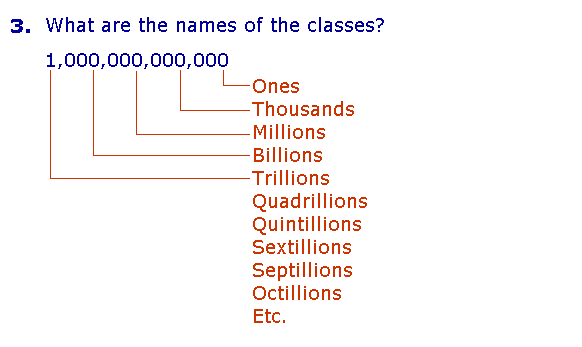 | Starting with Billions (bi for two), each class has a Latin prefix. To read a number more easily, we separate each class -- each group of three digits -- by commas. In Lesson 1 we showed how to read and write any number from 1 to 999, which are the numbers in the class of Ones. Together with knowing the sequence of class names, that is all that is necessary to be able to read any whole number. | | | | 4. | How do we read a whole number, however large? | | | | 256,312,785,649,408,163 | | | | | Starting from the left, read each three-digit group; then say the name of its class. | | |
| Example 1. Read this number: 256,312,785,649,408,163 Answer. Starting from the left, 256, read each three-digit group. Then say the name of the class. 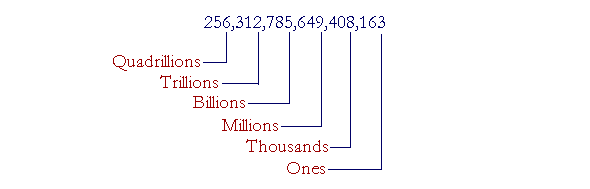 Say: "256 Quadrillion, 312 Trillion, 785 Billion, 649 Million, 408 Thousand, 163." Do not say the class name "Ones." Example 2. To distinguish the classes, place commas in this number: 8792456 Answer. Starting from the right, place commas every three digits: 8,792,456 Read the number: "8 million, 792 thousand, 456." Example 3. Read this number: 7,000,020,002 Answer. "Seven billion , twenty thousand, two." When a class is absent, we do not say its name; we do not say, "Seven billion, no million, ..." Also, every class has three digits and so we must distinguish the following: | 002 | "Two" | | 020 | "Twenty" | | 200 | "Two hundred" |
As for "and," in speech it is common to say "Six hundred and nine," but in writing we should reserve "and" for the decimal point, as we will see in the next Lesson. (For example, we should write $609.50 as "Six hundred nine dollars and fifty cents." Not "Six hundred and nine dollars.") Example 4. Write in numerals: Four hundred eight million, twenty-nine thousand, three hundred fifty-six. Answer. Pick out the classes: "million", "thousand". Each class (except perhaps the first class on the left) has exactly three digits: 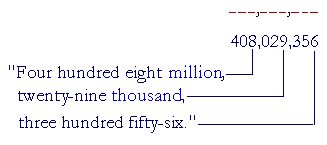
Example 5. Write in numerals: Five billion, sixteen thousand, nine. Answer. After the billions, we expect the millions, but it is absent. Therefore write 5,000,016,009 Again, we must write "sixteen thousand" as 016; and "nine" as 009; because each class must have three digits. The exception is the class on the extreme left. We may write "Five" as 5 rather than 005. When writing a four-digit number, such as Four thousand five hundred, it is permissible to omit the comma and write 4500. In fact, we often read that as "Forty-five hundred." But when a number has more than four digits, then for the sake of clarity we should always place the commas. Example 6. Distinguish the following: | a) Two hundred seventeen million | b) Two hundred million seventeen | | | | Answers. | | a) 217,000,000 | b) 200,000,017 |
| 5. | To which place does each digit belong? Equivalently, what is the unit at each position? | | | 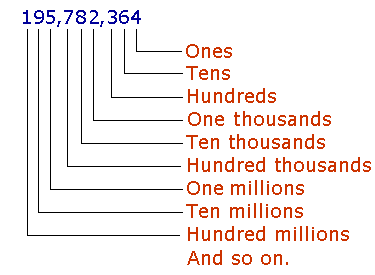 | | | | | Starting with the Ones on the right, each place belongs to the next power of 10. | | |
| Example 1. In this number, 139,072,658 the 0 is in which place? Answer. Hundred thousands. For, in each class of three digits, there are Ones, Tens, and Hundreds. 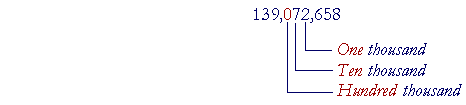 0 is in the class of thousands and in the Hundreds place. The power of 10 at that position is Hundred thousands. Example 2. In this number, 386,214,035 how many Ten millions are there? That is, which digit is in the ten millions place? Answer. 8. For, on counting from the right, the millions are the third group of three digits, 386. The Tens place is the middle one (Ones, Tens, Hundreds). There are 8 Ten millions. Place value versus absolute value of a digit In addition to speaking of a digit being "in" a place, we also speak of the place value of the digit itself. In this number, 6,666 each digit has the same absolute or invariable value 6, but a different place value. 6 on the extreme left has the place value 6000; the next 6 has the value 600; the next, 60; and the last, 6. Expanded form The numeral for every whole number stands for a sum. 364 = 3 Hundreds + 6 Tens + 4 Ones. (Even a single digit stand for a sum: 5 = 1 + 1 + 1 + 1 + 1.) What is written above is called the expanded form of 364. | | | | 6. | What does it mean to write a number in expanded form? | | | | | It means to write the sum that the number indicates, and therefore to name the unit at each digit's place. | | |
| Example 3. Write 6,325 in expanded form. Answer. Write 6,325 = 6 Thousands + 3 Hundreds + 2 Tens + 5 Ones. In practice, however, it is often more useful to expand the number in this way: 6,325 = 6,000 + 300 + 20 + 5. Example 4. Write the expanded form of 10,000. Answer. 10,000 = 1 Ten-thousand + 0 Thousands + 0 Hundreds + 0 Tens + 0 Ones. | | | Example 5. | | 42 | = | 40 + 2 | | | | -- no matter what the unit. | | | | | 42 eggs | = | 40 eggs + 2 eggs | | | | | 42 tens | = | 40 tens + 2 tens | | | | | 42 hundreds | = | 40 hundreds + 2 hundreds |
And so on. For there is no "42" apart from 42 units, even though we do not say the word units. Units of adjacent place value The following question is to prepare for the standard written methods ofaddition and subtraction. The answer follows from the fact that each digit 6,325 has a place value ten times the digit to its right. For, each power of 10 is ten times the one to its right: 1000 100 10 1 1000 is made up of ten 100's. 100 is made up of ten 10's. 10 is made up of ten 1's. And so on. | | | | 7. | What is the relationship between units of adjacent place value? | | 1000 100 10 1 | | | Ten units of lower place value can be composed -- gathered together -- to make one unit of the next higher value. | | | | | Equivalently: One unit of higher place value can bedecomposed -- broken up -- into ten units of the next lower value. | | |
|

Ten 1's can be composed into one 10. Ten 10's can be composed into one 100. Ten 100's can be composed into one 1000. And so on. Conversely: 1000 100 10 1 One 1000 can be decomposed into ten 100's. One 100 can be decomposed into ten 10's. One 10 can be decomposed into ten 1's.  1000 100 10 1  We will see this when we come to regrouping in addition and subtraction. Rounding off | | 8. | How do we round off, or approximate, a whole number to a given place? | | | 1267 1300 1300 | | | | | Look at the digit to the right of the given place: hundreds for example (2). If the digit to the right is a 5 or greater, add 1 to the given place. If it is less than 5, leave the given place unchanged. In either case, replace all the digits to the right of the given place with 0's. | | |
| Example 6. Round off 6,528 to the nearest ten. Answer. 6,528 6,530 6,530 (The wavy equal signmeans "is approximately equal to.") 2 is in the tens place. To round off to the nearest ten, look at the digit to the right: 8 (greater than 5). Therefore, add 1 to the tens place. Replace 8 with 0. Example 7. Round off 6,528 to the nearest hundred. Answer. 6,5286,500 5 is in the hundreds place. To round off to the nearest hundred, look at the digit to the right: 2 (less than 5). Therefore, leave the hundreds place unchanged. Replace 28 with 00. Example 8. Round off 6,528 to the nearest thousand. Answer. 6,5287,000 6 is in the thousands place. To round off to the nearest thousand, look at the digit to the right: 5. Therefore, add 1 to the thousands place. Replace 528 with 000. Example 9. Round off 79,521 to the nearest thousand. Answer. 79,52180,000 9 is in the thousands place. To round off to the nearest thousand, look at the digit to the right: 5. Therefore, add 1 to 79 -- it becomes 80. Replace 521 with 000.
| 9. | How do we multiply a whole number by a power
of 10? | | 28 × 10 | | | | | Add on as many 0's as appear in the power. | | |
|
| Example 1. | 28 × 10 | = | 280 | | Add on one 0. | | | | | 28 × 100 | = | 2800 | | Add on two 0's. | | | | | 28 × 1000 | = | 28,000 | | Add on three 0's. |
We can do that because of our system of positional numeration.
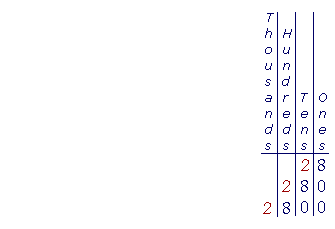 Look at 28 in the figure, and let us push each digit one place left, so that it becomes 280. 280 is then ten times 28, because each digit's place value is now ten times more. (In 28, the '2' tells how many tens, but in280 it tells how many hundreds.) Similarly, 2800 = 100 × 28.
Example 2. 608 is 608 ones. How much are 608 tens? 608 hundreds? 608 thousands? Answers. "608 tens" is 608 × 10. That is the meaning of multiplication (Lesson 9). 608 tens therefore are 6,080. Simply add on a 0. 608 hundreds = 608 × 100 = 60,800. Add on two 0's. 608 thousands = 608 × 1000 = 608,000. Add on three 0's.
Example 3. a) 50 ones are equal to how many tens? Answer. 50 ones are simply 50, or 5 tens. b) 50 tens are how many hundreds? Answer. 50 tens = 500. (Add on a 0.) 50 tens are 5 hundreds. c) 50 hundreds are how many thousands? Answer. 50 hundreds = 5000. (Add on two 0's.) 50 hundreds are5 thousands. d) 5000 is how many tens? Answer. 5000 = 500 × 10. 5000 is 500 tens. | | 10. | When a whole number ends in 0's, how do we divide it by a power of 10? | | | | 42,000 ÷ 10 | | | | | Take off as many 0's as appear in the power. | | |
|
| Examples. | 42,000 ÷ 10 | = | 4,200 | Take off one 0. | | | | | 42,000 ÷ 100 | = | 420 | Take off two 0's. | | | | | 42,000 ÷ 1000 | = | 42 | Take off three 0's. |
Problem. Reduce this fraction to its lowest terms: Answer. To reduce a fraction, we must divide both the numerator and denominator by the same number. Now, if a number ends in 0, then we know that it is divisible by 10; while if a number ends in two 0's, we know that it is divisible by 100. Both 300 and 500 then are divisible by 100:
|
|
|
|
نويسنده :حسین ساعدی Hossein Saedi
تاريخ: سه شنبه چهاردهم آذر ۱۳۹۱ ساعت: 10:8 PM
Saédi H Group A
Pre-U (1+2)
I. Choose the best selection.
01.Food that has a lot of ……….. in it can make you fat.
1.support
2.calories
3.fuel
4.shapes
02.Your ……….. beats faster when you exercise.
1.heart
2.joint
3.blood
4.vessel
03.When you eat food, your body uses some of the ……… in the food as fuel.
1.nutrients
2.muscles
3.vessels
4.blood
04.I ……… the idea to him and he seemed to like it.
1.caused
2.mentioned
3.created
4.organised
05.Nowdays we ……… on computers in our daily life.
1.depend
2.point
3.observe
4.protect
06.Regular exercise ……. your chance of living longer.
1.decreases
2.increases
3.lowers
4.includes
07.To keep …….. be careful of not eating too much.
1.healthy
2.exercise
3.in shape
4.memory
08.In order to be accepted in the university you should use your time more ……… .
1.commonly
2.previously
3.informally
4.efficiently
09.I …….. my arm to take the book from the bookshelf.
1.pushed
2.bent
3.streched
4.puklled
10.the government should ……….. enough jobs for unemployed.
1.release
2.create
3.define
4.complete
11.Don’t ask ………. questions, you are bothering me.
1.effective
2.repetitive
3.attractive
4.expensive
12.too much …. on meat will be harmful for your health.
1.fat
2.oil
3.fuel
4.energy
13.These teaching materials can be ……. for older children.
1.protected
2.encouraged
3.predicted
4.adapted
14.In ………. to other recent video games, this one isn't very exciting.
1.description
2.experiment
3.comparison
4.population
15.The World Bank will only agree to make this loan if certain ………. are met.
1.observations
2.reactions
3.practices
4.conditions
16.When doing sit-ups, keep your hands crossed on your……. , rather than behind your neck.
1.lung
2.chest
3.liver
4.arm
17.The door was locked and we couldn't ……… the house.
1.get rid of
2.get into
3.get out
4.get away
18.I think we need to take a fresh look at the problem. The underlined
word means ……. .
1.previous
2.friendly
3.new
4.dense
19.One way to learn the poem is to say it to yourself ………… again.
1.meaninglessly
2.over and above
3.purposelessly
4.over and over
20.In a(n) …………. , the BBC admitted that it had given incorrect information.
1.acceptance
2.allowance
3.statement
4.entrance
**********************
21.Some people change their eating habits ………… they get older.
1.when
2.whether
3.so
4.since
22. can you study ………….. your friends are talking?
1.when
2.because
3.whether
4.since
23.We had to leave there just ………. the conversation was getting interesting.
1.since
2.whether
3.until
4.as
24.We have to write in French …….. they don’t understand Persian or English.
1.whether
2.when
3since
4.while
25. Joe is a clever boy but he is not so successful …….. his sister.
1.than
2.as
3.for
4.of
26.Mary and I have known each other ……….. we were at school.
1.when
2.whether
3.since
4.as
27. …………… you are tall or short, you can play this sport.
1.Since
2.As
3.When
4.Whether
28.I began to enjoy the job more ……… I got used to eat .
1.as
2.so
3.whether
4.although
29.You have to brush your teeth ………… you are young or old.
1..since
2.whether
3.when
4.as
30.his parents died in an accident …………. he was a little boy.
1.as
2.when
3.since
4.whether
31.I get more experienced ………. I get older.
1.since
2.whether
3.when
4.as
32.Jack hurt his back ...……… he was running for a bus.
1.when
2.whether
3.since
4.whether
33.Mr Brown couldn’t sell his house ………….. the prices were falling.
1.since
2.when
3.thus
4.unless
34.We are getting more pleased ………her health is gradually improving.
1.as
2.when
3.whether
4.so
35.The child hurt his thumb …………. he was playing with a hammer.
1..since
2.when
3.whether
4.although
36.Leave the keys at the front desk ……………. you leave.
1.since
2.whether
3.as
4.so
**********************
Start with walking.If you are overweight and if you have risk factors for heart disease - high ....37.... pressure, high cholesterol, or family history of heart disease - get your doctor's OK before starting an exercise program, Thompson says.Talk to a doctor first. Set short-term goals - 10 minutes, 15 minutes, etc. Gradually ..... 38.... the number of days. Walking a dog is great because it gets you out for 20 minutes in the morning, and then 20 more at night. "If I can get someone up to 45 minutes or an hour of exercise during the day, I consider that a major success," Thompson notes. "You can't ask anyone to ....39..... start exercising for 90 minutes. You have to start with lifestyle changes and increase from there." Buy or rent traning tapes or DVDs. If you prefer a quiet start to the day, try tapes and DVDs that feature yoga, and ....40..... training programs. Be sure to check who created them.
37.
1.vessel
2.lung
3.bone
4.blood
38.
1.decrease
2.increase
3.reduce
4.lesson
39.
1.immediately
2.generally
3.purposelessly
4.informally
40.
1.nutrient
2.endorphin
3.aerobic
4.nervous
41.Good eye contact helps your audience ----- more relaxed.
1. feel
2. feeling
3. feels
4. felt
**********************
42.The teacher made all the students ----- a lecture during the term.
1. to give
2. gives
3. give
4. giving
43.By ----- number 110 , the police help you.
1. call
2. calling
3. to call
4. calls
44.My brother forced me ----- my homework.
1. doing
2. to do
3. does
4. did
45.The bed was so ----- that I didn't like to get up.
1. wonderful
2. reliable
3. probable
4. comfortable
46.I was too tired. That is why I stopped -----.
1. relaxing
2. to relax
3. relax
4. relaxed
47.How did Mary ----- when she heard about the accident?
1. force
2. react
3. mention
4. affect
48.Face to face words can have a stronger ----- than the message.
1. effect
2. gesture
3. respect
4. future
49.She can't ----- on her lessons with all that noise.
1. control
2. concentrate
3. understand
4. disturb
50.Most of the young people have a ----- opinion about future.
1. positive
2. lazy
3. facial
4. comfortable
51.Don't ----- against the chair while you are talking to your teacher.
1. leave
2. stay
3. lean
4. cycle
52.The ----- on Mary's face showed that she was very excited.
1. reaction
2. decision
3. attention
4. expression
53.Mrs Ahmadi is quite ----- because she has lost her job.
1. facial
2. nervous
3. positive
4. negative
54.Having eye ----- with the audience makes your speech more effective.
1. contact
2. confidence
3. capacity
4. communication
55.The doctor asked Reza to breathe deeply so that he could ------ his lungs.
1. affect
2. accept
3. choose
4. check
56.Nowadays ----- with each other is easier and faster than the past.
1. observation
2. concentration
3. communication
4. presentation
57.Mr Moosavi seemed very angry and spoke in an impolite -----.
1. tap
2. term
3. tool
4. tone
58.Take a short look at yourself in the ----- before leaving the house.
1. movement
2. mine
3. mirror
4. mood
59.Most of the people have a fear to speak in -----.
1. state
2. stance
3. posture
4. public
60.People always ----- Mr Brown because he's a very honest person.
1. disturb
2. respect
3. involve
4. raise
**********************
A father noticed that his son was spending too much time playing computer games. In an effort to motivate the boy into focusing attention on his schoolwork, he said to his son, “When Abe Lincoln was your age, he was studying books by the light of the fire place.” The son replied, “When Lincoln was your age, he was the president of the United States.”
61.According to the story you have just read the father is …… .
1.worried about his son
2.a little bit stupid
3careless man
4.collecting votes for the president of USA
62.In the story above the word “he” in line 2 refers to …… .
1.the son’s father
2.the son
3.Lincoln
4.the president
63.In the passage the boy is …… .
1.Lincoln’s son
2.Lincoln’s friend
3.interested in studying
4.careless about his lessons
64.According to the passage Lincoln …… .
1.had a hard time when he was a little boy
2.did his homework in a room with no light
3.had an easy time when he was a little boy
4.did his studies in a room with a lot of light
65.The father thinks Abe Lincoln as …… .
1.a good example that should be followed by
2.a bad example that shouldn’t be followed by
3.a bad president who couldn’t help his country
4.a selfish president who could be forgotten
The first few times a person smokes, the smoker usually feels terrible. In a few day the smoker’s body gets used to the medicine and the smoker feels fine. Later, the smoker needs nicotine o feel fine, without it, the smoker feels terrible. The smoker is addicted.
32.Smoking in the first few times …… .
1.is a good experience for a new smoker
2.gives a very bad feeling to the new smoker
3.is always a nice feeling for a new smoker
4.makes a new smoker feel peace
66.The word it in line 3 refers to ……. .
1.the smoker
2.nicotine
3.smoking
4.a person
67.If smoking gives a good feeling to a person who always smokes …… .
1.he will not be a poor person
2.he can’t be addicted to nicotine
3.he will be a poor person
4.he must be addicted to nicotine
نويسنده :حسین ساعدی Hossein Saedi
تاريخ: یکشنبه سوم اردیبهشت ۱۳۹۱ ساعت: 10:42 PM
|
| | |


